A Few of My Favorite (hypermobility & dysautonomia) Things!
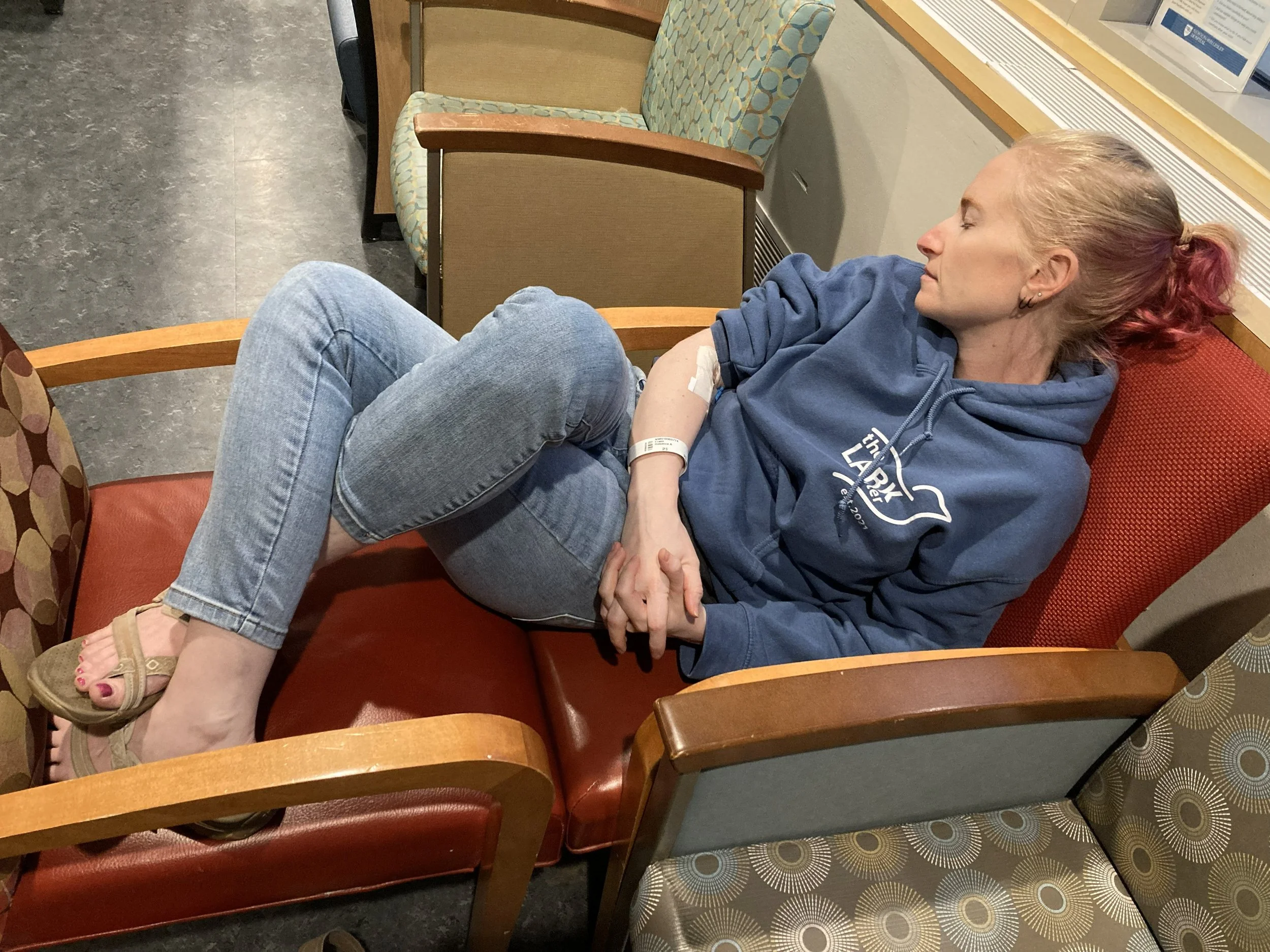
Becca relaxing at the hospital after getting fluids for a POTS episode. Notice the leg wrap posture for increased joint stability.
Many of my friends, clients, and colleagues know me well for my creative, impulsive, expressive, impassioned, obsessive, distracted, and determined ADHD brain. My pride in my ADHD identity (as well as my acknowledgment of my areas of support needs) helps me to form meaningful and trusting relationships with my neurodivergent clients, families, and staff. It helps me to relate to the sensory stresses, the time thieves, the wild emotional rollercoasters - and helps me to meet people with understanding, compassion, and actually relevant supports. What an asset as a therapist!
Something that you may not know about me is my other disability identity. I am (what we in the community refer to as) a “Zebra.” I have Ehlers Danlos Syndrome (EDS) and the accompanying annoyances of POTS (postural orthostatic tachycardia syndrome) and MCAS (mast cell activation syndrome). EDS is a group of disorders in which the collagen in your body is faulty, resulting in soft tissues that don’t function as they “should.” There are over 14 different sub-types of EDS, depending on exactly what is wrong with your collagen and how it impacts you. My type is the most common: hypermobile EDS. My joints are too loose, my skin is too stretchy, my muscles are too spasm-y, my bones are too weak, my organs don’t stay where they should… and the list goes on. We are lovingly referred to as “Zebras” based on the classic adage doctors learn in medical school about if you hear hoof beats, think horse not zebra (or something like that.) Meaning, it is much more likely to be what you think it is - what you normally expect - than to be something atypical or rare. Well, with hypermobile folks, you have to think Zebra because EDS-ers do not present in average or common ways and often defy what they teach in medical textbooks. When a doctor says, “but that’s not medically possible,” you better believe that it IS when you have EDS.
There is no “cure” for Ehlers Danlos Syndrome, or POTS, or MCAS. It is important to prevent and manage symptoms as much as possible in order to maintain as much function as you can. While my hypermobility makes my days often very painful and my POTS can make fatigue and dizziness disabling, there are certain things I do daily to increase my comfort, ability to function, and overall quality of life. Here is a list I have put together of some of my favorite tools that improve my daily life and allow me to continue to enjoy my work, my family, and my hobbies. Hopefully, you and/or the disabled people in your life can benefit from some of them as well. Click here to see my top 10!
If you would like to know more about hypermobility, Ehlers Danlos Syndrome, or the high rate of overlap between neurodivergence and hypermobility, please reach out! contact@thelarkcenter.com. (I sense another blog post coming soon on this topic…)
Also, I recommend that everyone (whether you are hypermobile or not) watch the documentary COMPLICATED. It is such an eye opening and tender look at the vast misconceptions, misidentification, and mismanagement of Ehlers Danlos Syndrome, especially in kids. Here is a link to the movie’s webpage. Be on the lookout for screenings!